> ## Documentation Index
> Fetch the complete documentation index at: https://dapplets.mintlify.site/llms.txt
> Use this file to discover all available pages before exploring further.
# Universal LifeCycle
> In the Mutable Web, every interaction with applications, mutations, and objects follows a consistent workflow, ensuring a seamless and efficient user experience. This universal lifecycle comprises three key stages: Local Change, Publish, and Pull Request.
 ## Semantic Context
The Mutable Web introduces a structure where each object—whether it’s a **mutation** or a **document**—follows a consistent lifecycle involving **local edits** and **potential publication**.
The process applies universally across all applications, mutations, or objects:
```text theme={null}
LocalChange => Publish (as Fork, as Update) => Pull Request
```
## Key Stages of the Lifecycle
### **1. Local Change**
When a user initiates an interaction, such as creating or editing an object, changes occur **locally** in their environment. This approach allows users to make multiple adjustments before deciding to make them public.
**Visibility Settings During Local Changes:**
* **`Private`:** Accessible only via ID; not visible in search results or public lists.
* **`Devel`:** Visible only in **developer mode**, ideal for testing and iteration.
* **`Public`:** Fully visible and searchable by others.
This local-first approach ensures flexibility without risking unintended public exposure.
### **2. Publish (as Fork or Update)**
Once satisfied with local changes, users can **publish** their modifications. The method of publication depends on **ownership**:
* **Fork:** If the object was created by someone else, the user forks it to create an independent version.
* **Update:** If the object is the user’s original creation, they can directly publish it as an **update**.
**Context-Sensitive Publish Button:**
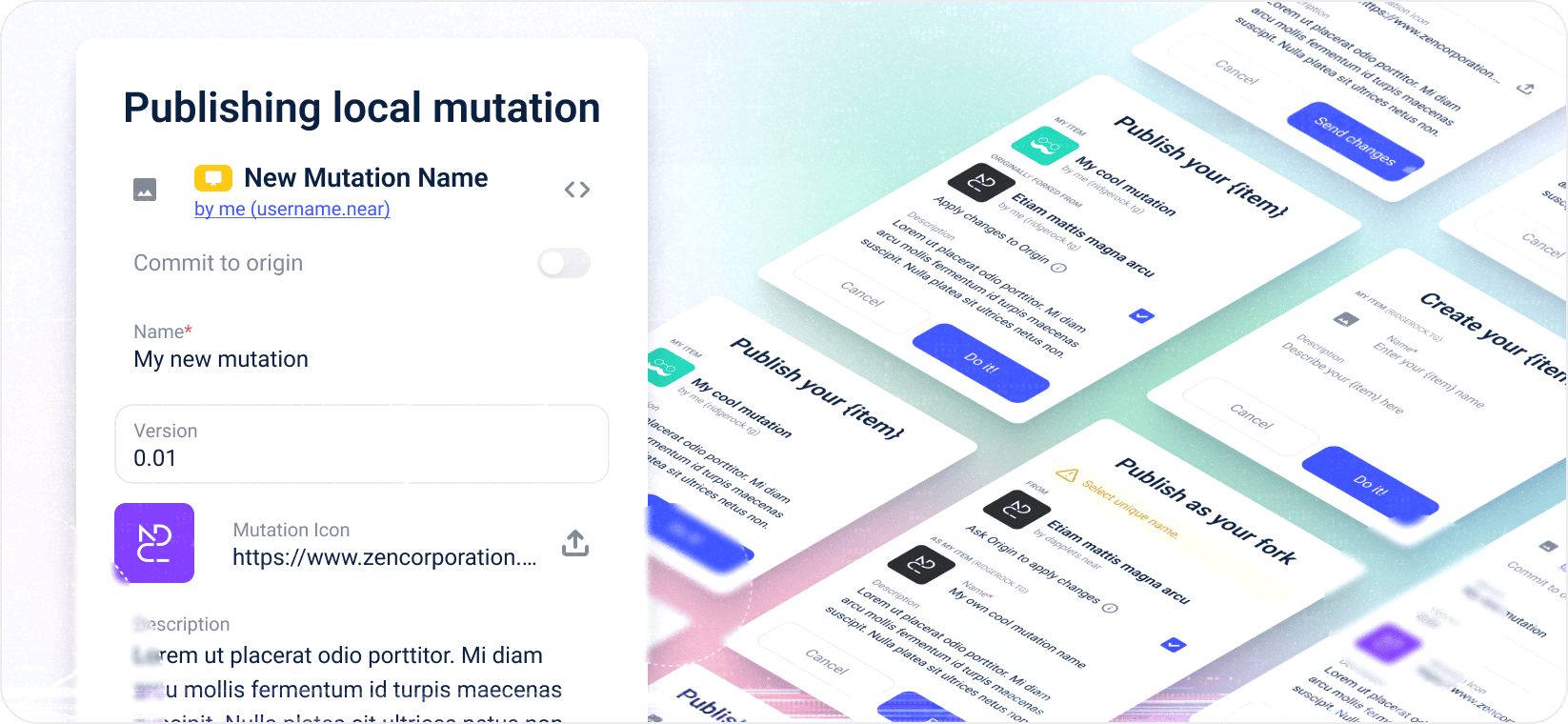
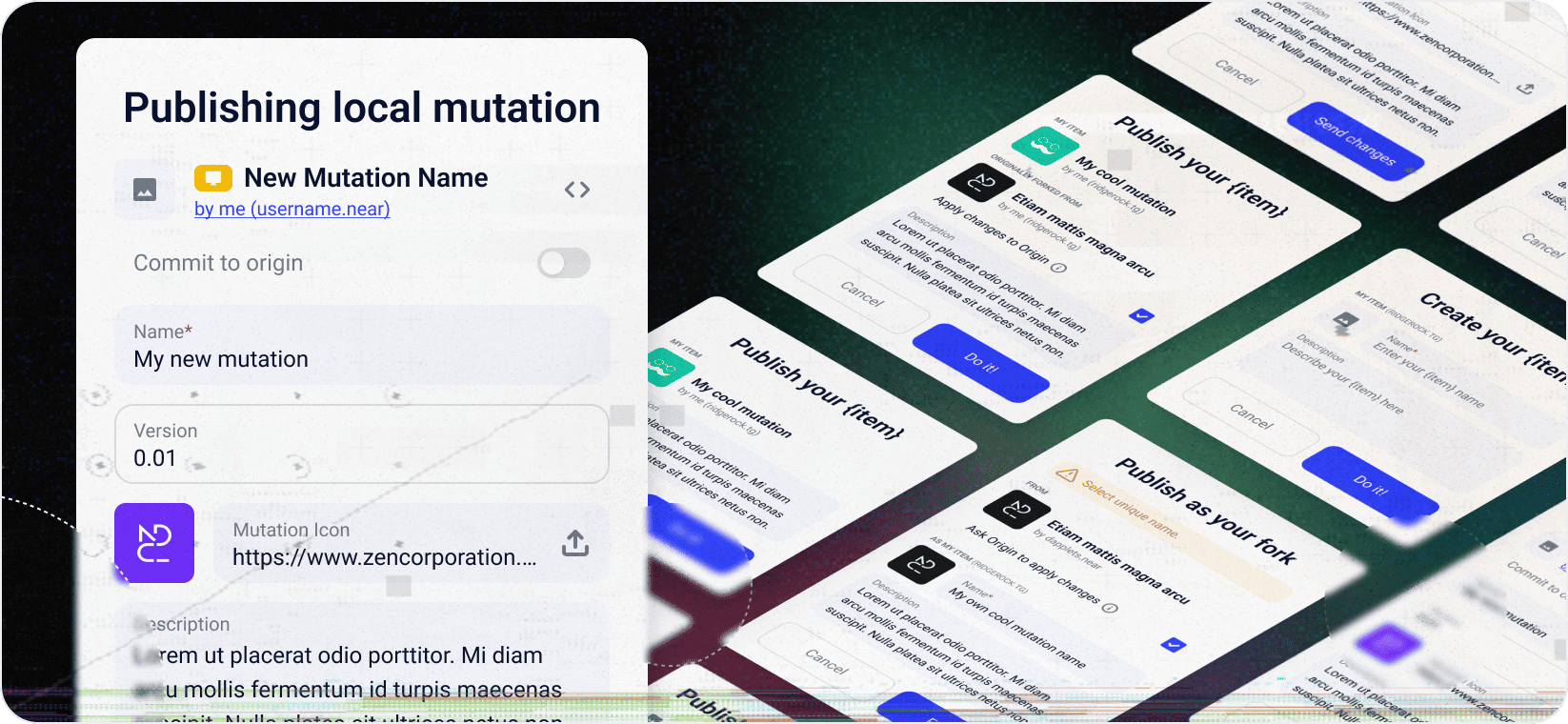
The **Publish** button dynamically adapts based on the object’s origin and state, offering the option to **notify the original author** via a `notify origin` checkbox.
`Forking a Foreign Mutation:` Fork another author’s mutation, make adjustments, and publish it independently.
`Forking Your Own Mutation:` Fork your mutation to branch into separate versions (e.g., testing vs. production).
### **Creating a Mutation from Scratch**
Users can also create a **new mutation** without forking an existing one. In this scenario:
* The mutation starts with a **null ID**.
* Once published, it generates a **unique ID**.
### **3. Pull Request**
Integrated into the **Publish** action, the **Pull Request** mechanism allows users to propose changes to the original author.
* By selecting the **`notify origin`** option during publication, the original author is alerted about the proposed modifications.
* This facilitates **collaboration** and **iterative improvements**.
This structured workflow ensures **systematic interaction management**, fostering a collaborative and user-centric environment.
## Special Cases in the LifeCycle
## Semantic Context
The Mutable Web introduces a structure where each object—whether it’s a **mutation** or a **document**—follows a consistent lifecycle involving **local edits** and **potential publication**.
The process applies universally across all applications, mutations, or objects:
```text theme={null}
LocalChange => Publish (as Fork, as Update) => Pull Request
```
## Key Stages of the Lifecycle
### **1. Local Change**
When a user initiates an interaction, such as creating or editing an object, changes occur **locally** in their environment. This approach allows users to make multiple adjustments before deciding to make them public.
**Visibility Settings During Local Changes:**
* **`Private`:** Accessible only via ID; not visible in search results or public lists.
* **`Devel`:** Visible only in **developer mode**, ideal for testing and iteration.
* **`Public`:** Fully visible and searchable by others.
This local-first approach ensures flexibility without risking unintended public exposure.
### **2. Publish (as Fork or Update)**
Once satisfied with local changes, users can **publish** their modifications. The method of publication depends on **ownership**:
* **Fork:** If the object was created by someone else, the user forks it to create an independent version.
* **Update:** If the object is the user’s original creation, they can directly publish it as an **update**.
**Context-Sensitive Publish Button:**
The **Publish** button dynamically adapts based on the object’s origin and state, offering the option to **notify the original author** via a `notify origin` checkbox.
`Forking a Foreign Mutation:` Fork another author’s mutation, make adjustments, and publish it independently.
`Forking Your Own Mutation:` Fork your mutation to branch into separate versions (e.g., testing vs. production).
### **Creating a Mutation from Scratch**
Users can also create a **new mutation** without forking an existing one. In this scenario:
* The mutation starts with a **null ID**.
* Once published, it generates a **unique ID**.
### **3. Pull Request**
Integrated into the **Publish** action, the **Pull Request** mechanism allows users to propose changes to the original author.
* By selecting the **`notify origin`** option during publication, the original author is alerted about the proposed modifications.
* This facilitates **collaboration** and **iterative improvements**.
This structured workflow ensures **systematic interaction management**, fostering a collaborative and user-centric environment.
## Special Cases in the LifeCycle
 ### **Editing Your Own Mutation Without an Origin**
When editing a mutation **without an origin** (not forked from another mutation):
* Changes are treated as **updates**.
* No local copy is created.
* The **ID remains unchanged**.
### **Editing a Mutation with an Origin (Foreign Author)**
When editing a **forked mutation** based on another author’s work:
* Changes remain **local** until published.
* **Origin metadata** is preserved.
* A **`Publish as Fork`** operation is required to maintain the mutation's history.
### **Publishing a Fork**
When publishing a fork:
* The **original mutation remains unaltered**.
* The forked version receives a **unique ID**.
* Forks can be further **edited, published, or forked again**.
## Fork and Edit Lifecycle
Each mutation follows a lifecycle based on its origin and editing context:
Create a new branch from an existing mutation for independent development.
Branch out versions of your mutation for different use cases (e.g., production vs. testing).
Start fresh with a new mutation, generating a unique ID upon publication.
Directly update your original mutation without creating a separate fork.
Modify a forked mutation, maintaining origin metadata for clarity and traceability.
This systematic approach ensures clarity and consistency across different mutation workflows.
The **Mutable Web Lifecycle** provides a robust structure for managing changes, fostering collaboration, and ensuring adaptability across diverse use cases.
Whether you’re an **end-user**, **developer**, or **community contributor**, understanding and following these workflows is key to building an efficient, decentralized, and adaptive internet.
**Let’s create, share, and innovate—together.**
### **Editing Your Own Mutation Without an Origin**
When editing a mutation **without an origin** (not forked from another mutation):
* Changes are treated as **updates**.
* No local copy is created.
* The **ID remains unchanged**.
### **Editing a Mutation with an Origin (Foreign Author)**
When editing a **forked mutation** based on another author’s work:
* Changes remain **local** until published.
* **Origin metadata** is preserved.
* A **`Publish as Fork`** operation is required to maintain the mutation's history.
### **Publishing a Fork**
When publishing a fork:
* The **original mutation remains unaltered**.
* The forked version receives a **unique ID**.
* Forks can be further **edited, published, or forked again**.
## Fork and Edit Lifecycle
Each mutation follows a lifecycle based on its origin and editing context:
Create a new branch from an existing mutation for independent development.
Branch out versions of your mutation for different use cases (e.g., production vs. testing).
Start fresh with a new mutation, generating a unique ID upon publication.
Directly update your original mutation without creating a separate fork.
Modify a forked mutation, maintaining origin metadata for clarity and traceability.
This systematic approach ensures clarity and consistency across different mutation workflows.
The **Mutable Web Lifecycle** provides a robust structure for managing changes, fostering collaboration, and ensuring adaptability across diverse use cases.
Whether you’re an **end-user**, **developer**, or **community contributor**, understanding and following these workflows is key to building an efficient, decentralized, and adaptive internet.
**Let’s create, share, and innovate—together.**